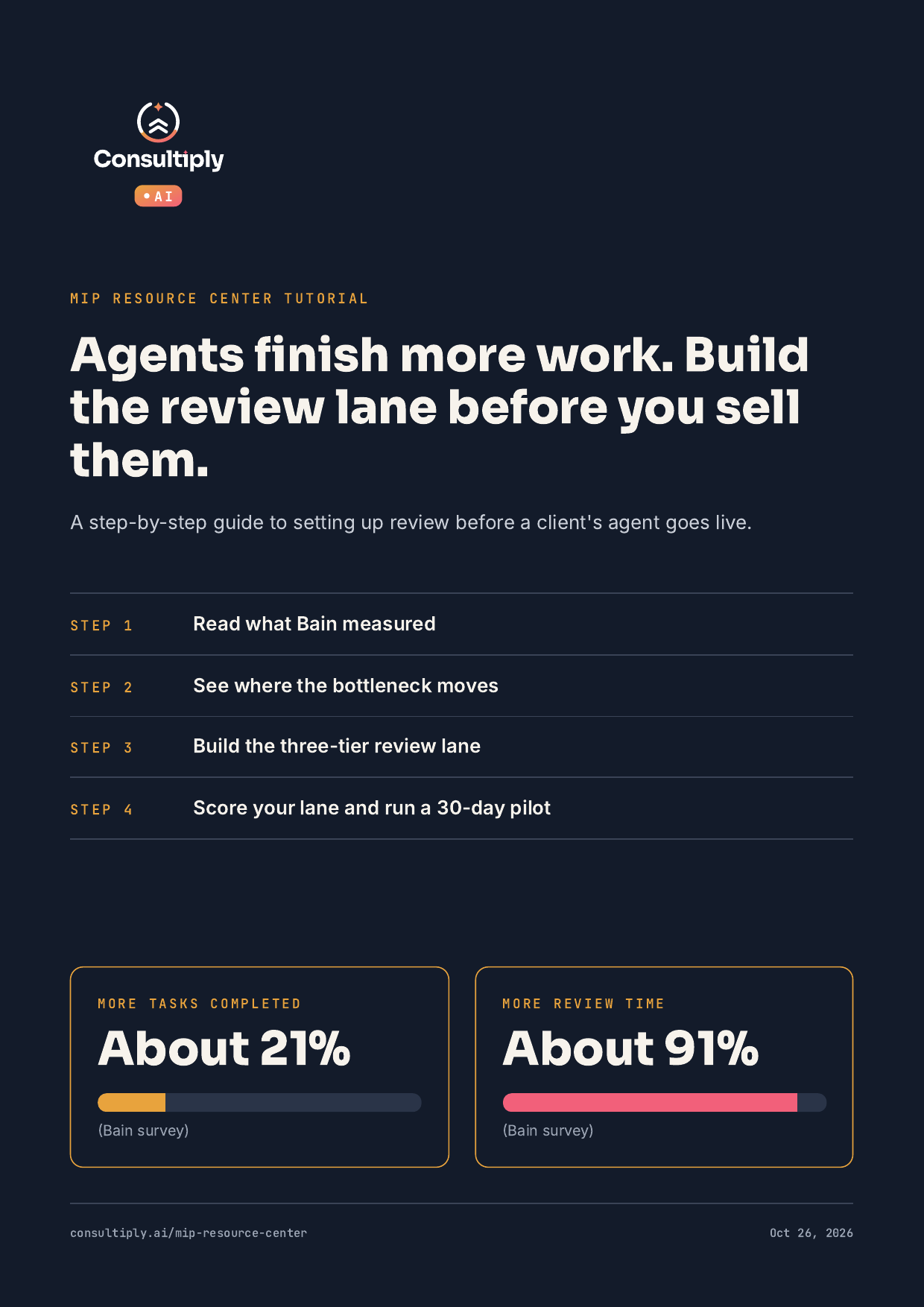
Agents finish more work. Build the review lane before you sell them.
Bain's Technology Report 2026 found that AI lifts developer output but nearly doubles review time. What that means for MSPs rolling out agents for clients, and a three-tier review lane to set before go-live.
Published October 26, 2026 · ~6 min read
What Bain published
On September 29, 2026, Bain & Company published its Technology Report 2026. One chapter, "The Missing Architecture for Agentic Software Development", looks at what happens after companies give their teams AI that writes code. It draws on Bain's Tech and Engineering Survey of 293 senior technology leaders, run in April 2026.
These are findings about software development teams, not MSPs or small businesses. We read the chapter because the pattern Bain describes is the one an MSP meets as soon as an agent starts doing real work for a client: the work gets faster, and checking it becomes the job.
Where the bottleneck moved
Bain's survey found that developers "complete roughly 21% more tasks but review time rises approximately 91%" (Bain, p.68). Output went up by about a fifth. Time spent checking it nearly doubled. In Bain's words, AI speeds up individual tasks, "but the bottleneck shifts to everything around the code" (p.68).
Bain's warning is that faster output without a redesign does not add up to faster delivery. The system "reverts to the throughput of its slowest human checkpoint" (p.69).
Swap code for ticket replies, user changes, client emails or monthly reports and the lesson carries over. If an agent produces work faster than a technician can read it, the technician sets the pace. If nobody reads it, unchecked work reaches the client.
Bain's numbers, and what they are
Tasks completed by developers using AI
Roughly 21% more. Status: Bain survey (p.68).
Review time
Approximately 91% more. Status: Bain survey (p.68).
Companies that expect a risk-tiered model
41%. Status: Bain survey (p.70).
Companies that envision fully autonomous development
6%. Status: Bain survey (p.70).
Respondents
293 senior technology leaders, April 2026. Status: Bain survey (p.68).
Every figure is Bain's own and comes from the senior technology leaders Bain surveyed. None of them measures MSPs or their clients.
Why this matters for an MSP
Clients who ask for agents usually expect fewer hours of work. Bain's data says the hours move, from doing the work to checking it. An MSP that sells agent output without a review design inherits that bottleneck, either as unbilled technician time or as errors the client finds first.
Bain's respondents also say what matters most for scaling. They ranked governance, safety and risk controls as the top enablers for scaling agentic AI, ahead of model quality, data infrastructure and platform investment (p.70). Only 6% envision fully autonomous development, while 41% expect a risk-tiered model (p.70). The leaders Bain surveyed are not planning for agents that run unchecked. They are planning for controlled delegation.
The review lane: three tiers to set before go-live
Bain's core principle is short: "Automate routine verification so that humans can focus on decisions that require judgment" (p.70). For an MSP, we would turn that into a review lane with three tiers. The tiers are Consultiply's reading, not a Bain framework.
Tier 1, automated checks.
Rules a machine can check on every output: required fields, format, allowed systems, policy terms, volume or spend limits. A failed check sends the work back to the agent or to a queue, never to the client.
Tier 2, sampled human review.
Low-risk work that passed tier 1. A technician reviews a fixed sample each day and records every change made. If the correction rate climbs, the sample grows.
Tier 3, approval before action.
Anything hard to undo, or anything touching money, access or client communication outside the agreed scope. The agent proposes, a named person approves, and the approval is logged.
Bain describes the same shape in the companies pulling ahead: a quality layer that checks agent work against written standards, with human judgment moving to exceptions and higher-risk decisions (p.70). It also stresses that "Audit trails capture every agent action, decision, and escalation for traceability" (p.70). For an MSP, that log is what makes the work defensible at the next client review.
Write the rules down so agents can use them
Bain's second lesson is about knowledge. People can infer and make reasonable guesses, "but agents need explicit organizational knowledge" (p.69). Bain recommends capturing that knowledge in structured specifications that act as a single source of truth (p.69).
For an MSP, the equivalent is each client's runbook: escalation paths, priority users, change windows, naming rules and the systems an agent may touch. If a rule is not written down, the agent guesses, and review time grows to catch the guesses.
A 30-day pilot to offer a client
Pick one workflow with a clear right answer,
such as ticket categorization or routine account requests.
Write the spec:
objective, scope, systems, what counts as done, and what must be escalated.
Build the tier 1 checks
before the agent goes live, not after the first mistake.
Assign tiers 2 and 3 to named technicians,
and log every correction and approval.
Measure for 30 days:
work completed, review minutes, correction rate and escalations. Keep agent work and human work in separate columns. Bain argues for "metrics that distinguish human and agent contributions" (p.71).
Decide with the client:
widen the agent's scope where corrections are rare, and tighten it where they are not.
Read with care
Survey scope.
Bain's figures come from a survey of 293 senior technology leaders and describe software development (p.68). They are not MSP or SMB measurements.
Rounded values.
Bain gives the task and review figures as rounded values ("roughly", "approximately").
Our suggestions.
The three-tier review lane and the 30-day pilot are Consultiply's suggestions, drawn from Bain's principles. Bain does not prescribe them for MSPs.
Examples left out.
Bain's chapter includes named company examples. We left them out because they describe large engineering organizations.
This guide is Consultiply's independent reading of Bain & Company's Technology Report 2026. It is not affiliated with or endorsed by Bain & Company, and it is not a recommendation to buy any product. Every figure is Bain's own.
Related reading: Trace the agent first. Widen its access second. and Let the AI technician suggest the fix. Keep the approval with your team..
Sources
The Missing Architecture for Agentic Software Development (Bain & Company, Purna Doddapaneni, Chris McLaughlin, Stanley Liu and Bill Radzevych, Sep 29, 2026), Technology Report 2026, pp.67 to 71.
Technology Report 2026 (Bain & Company, Sep 29, 2026).
Reviewed, not run by us.
Consultiply's independent reading of Bain & Company's Technology Report 2026; every figure is Bain's own and comes from Bain's survey of 293 senior technology leaders. Bain & Company: The Missing Architecture for Agentic Software Development (Technology Report 2026) →
