AI scans will find more holes. Plan who fixes them before you turn the scans on.
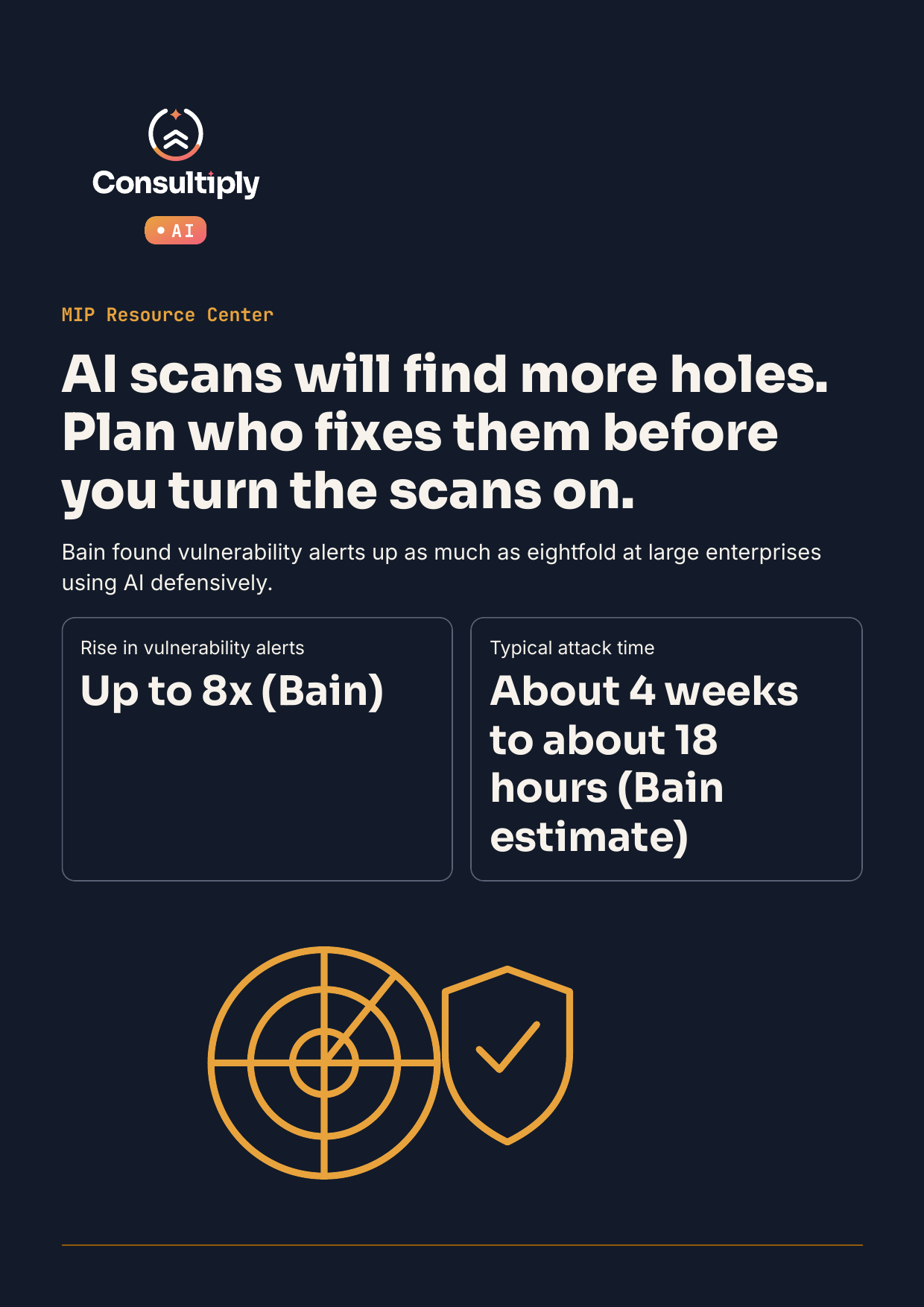
Bain's Technology Report 2026 found vulnerability alerts up as much as eightfold at large enterprises using AI defensively, and many companies unable to count their own agents. What MSPs can package: full-estate scanning, remediation capacity and an agent register.
Published November 9, 2026 · ~6 min read
What Bain published
On September 29, 2026, Bain & Company published its Technology Report 2026. Its cybersecurity chapter, "Cybersecurity's New AI Imperative: Attacking the Backlog of Vulnerability Alerts", describes what happens when large enterprises point AI at their own defenses. The findings draw on Bain's analysis and on chief information security officers (CISOs) at large enterprises.
None of this is MSP or SMB data. We read it because the same tools are reaching smaller environments, and the problem Bain describes is one an MSP will meet first: finding weaknesses is getting easy, and fixing them is not.
Faster attacks, and a flood of alerts
Bain estimates that AI has compressed the time a typical cyberattack takes from about 4 weeks to about 18 hours (p.45). Defenders are using AI too. Some big companies already run frontier AI to strengthen their defenses, "But that's creating its own challenge, with vulnerability alerts increasing by as much as eightfold" (p.46). Bain adds that these surges "can rapidly exceed a firm's ability to validate, prioritize, and fix weaknesses" (p.46).
For an MSP, the lesson is about order. If AI-powered scanning goes into a client environment before anyone has planned the fixing, the result is a longer list and a harder conversation with the client.
How leaders are responding
Bain reports that leading enterprises have increased remediation budgets, "typically by a double-digit percentage," while redirecting "as much as 20% to 25%" of their cybersecurity staff to fix alerts from AI-powered scans (p.46). They use third-party partners to keep normal operations running while they do it (p.46). One leader tripled the size of its remediation team (p.46).
They also stopped treating every finding the same. Bain says leaders look at "exploitability, reachability, systemic dependency, and blast radius" rather than analyzing vulnerabilities in a vacuum (p.46).
That detail about outside partners matters for MSPs. Even at large enterprises, extra hands are part of the answer.
Bain's numbers, and what they are
Every figure is Bain's own. "As much as" marks the top of a range, not a typical result.
| Claim | What was measured | Status |
|---|---|---|
| Rise in vulnerability alerts with AI-powered defenses | As much as eightfold. Bain, large enterprises (p.46) | Vendor claim |
| Time a typical cyberattack takes | About 4 weeks before AI, about 18 hours with it. Bain estimate (p.45) | Vendor claim |
| Security staff some leaders redirected to remediation | As much as 20% to 25%. Bain, large enterprises (p.46) | Vendor claim |
| Vulnerabilities found outside critical applications | More than half. Bain (p.47) | Vendor claim |
The agent blind spot
AI agents widen the attack surface too. Bain writes: "Many companies would struggle to say how many agents they have, who owns them, and what they are permitted to do" (p.45). Fewer still have taken the step Bain calls crucial: a kill switch in each agent (p.45).
An MSP is often the only party that sees every system a small client runs. That makes the agent inventory a natural thing for the MSP to keep. It also gives the MSP a clear, recurring service to offer: knowing what each agent can touch, and being able to turn it off fast.
What an MSP can package
This is Consultiply's reading of Bain's six imperatives (pp.47 and 48) for MSPs. Bain wrote them for large enterprises.
Full-estate scanning.
Bain: "More than half an organization's vulnerabilities are found outside critical applications" (p.47). Scan legacy systems, APIs, authentication and dependencies, not only the main business apps.
Remediation capacity, sized before the scan.
Bain advises building remediation capacity at the same time as scanning at scale, automating simpler fixes "with a human in the loop" and using third-party support (p.47).
Prioritization by reachability.
Group findings by what an attacker can actually reach and exploit, and by what else breaks if that system fails.
An agent register.
Every AI agent in the client's environment, with an owner, its permissions, the systems it touches and how to switch it off.
A retirement list.
Where patching is not viable, Bain says companies should be bold about "retiring vulnerable technology rather than relying on rolling stopgaps" (p.48).
Monthly reporting.
Bain wants board reports that are "granular, actionable, and at least monthly" (p.48). For a small client, that is the owner's monthly review.
A first 60 days with a client
Agree the remediation hours first.
Before any AI scan runs, set how many hours a month go to fixing, and who approves fixes.
Scan the full estate once
and group findings by reachability, not only severity.
Fix the simple items with automation and a human check,
and log each fix.
Build the agent register
in the same pass: owner, permissions, systems and off switch for each agent.
List what cannot be patched
and give the client a retirement plan with dates.
Report monthly
on findings opened, fixed and still open, in plain language.
Read with care
Large enterprises only.
Bain's findings describe large enterprises and their CISOs. The chapter gives no survey sample size, and none of the figures measures MSPs or small businesses.
Top of the range.
"As much as eightfold" and "as much as 20% to 25%" are the top of Bain's ranges.
An estimate.
The attack-time figure is Bain's estimate for a typical attack, not a measurement of any single incident.
Our suggestions.
The packaging list and 60-day plan are Consultiply's suggestions. Bain does not prescribe them for MSPs, and nothing here recommends a product.
This guide is Consultiply's independent reading of Bain & Company's Technology Report 2026. It is not affiliated with or endorsed by Bain & Company, and it is not a recommendation to buy any product. Every figure is Bain's own.
Related reading: Atlassian now gives every AI agent an identity. Start with the agent inventory. and Agents walk through the doors you left open. Close the conventional gaps first.
Sources
Cybersecurity's New AI Imperative: Attacking the Backlog of Vulnerability Alerts (Bain & Company, Syed Ali, Frank Ford, Matthew Leybold, Alexandra Juegelt and Dana Aulanier, Sep 29, 2026), Technology Report 2026, pp.44 to 48.
Technology Report 2026 (Bain & Company, Sep 29, 2026).
Reviewed, not run by us.
Consultiply's independent reading of Bain & Company's Technology Report 2026; every figure is Bain's own and describes large enterprises. Bain & Company: Cybersecurity's New AI Imperative: Attacking the Backlog of Vulnerability Alerts (Technology Report 2026) →
